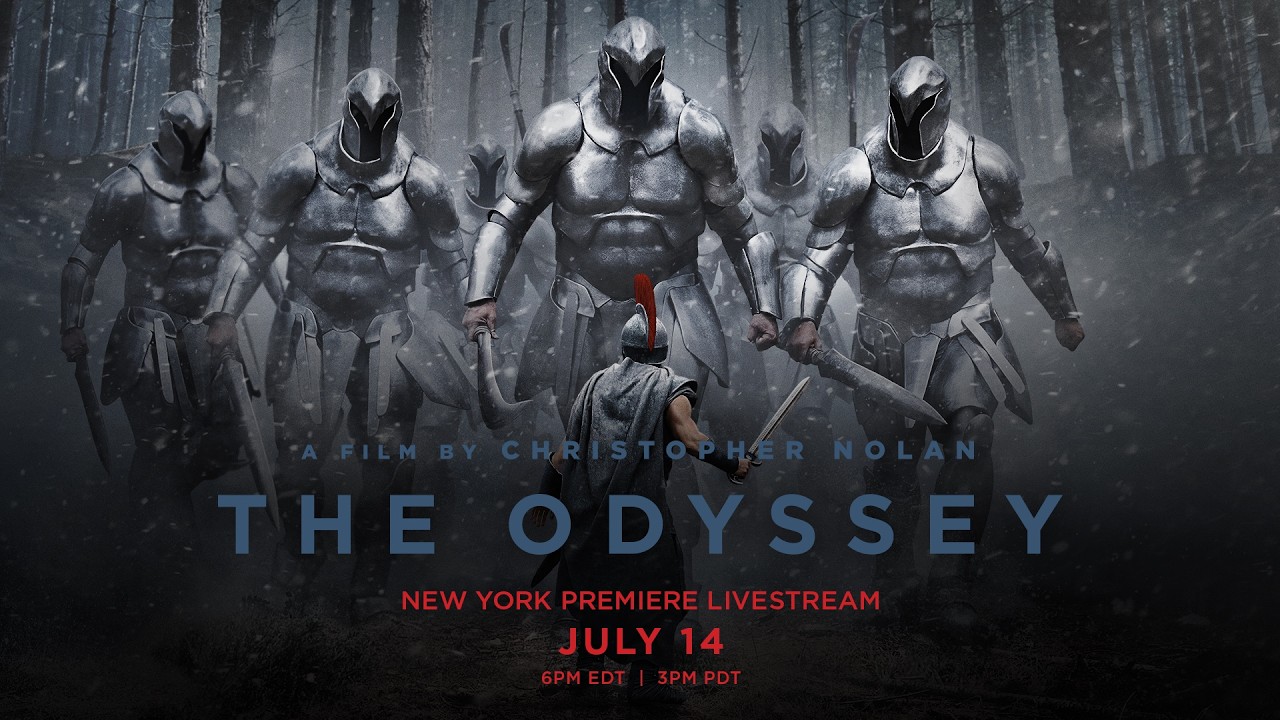
Christopher Nolan turns Homer’s epic into a breathtaking cinematic experience that is best enjoyed on the biggest screen possible. Beneath the mythology, battles and divine intervention is a deeply human story about war, loss, ego and the consequences of our choices. Matt Damon is excellent as Odysseus, the visuals are spectacular, and the music makes the 172-minute journey deeply immersive. While viewers who aren’t fans of mythology or epic fantasy may find the first half a little deliberate, the film builds beautifully into a gripping second half. For me, this might be one of Nolan’s best films since the Dark Knight trilogy.
⚠️ SPOILERS AHEAD
I have missed watching a Christopher Nolan movie in a theatre since Interstellar. So I was genuinely excited to finally watch The Odyssey on the IMAX screen. And I am glad I did.
The story of the Trojan War is familiar to most of us, but I had never read Homer’s Odyssey. Watching it unfold on a giant IMAX screen was therefore both an introduction to the epic and a spectacular cinematic experience. I watched Troy the previous night, which helped refresh some of the context and characters.
Troy deliberately stayed grounded as a war movie, avoiding the magical elements of mythology. The Odyssey cannot really do that. This is the story of Odysseus, the hero of Troy, attempting to return home after the war, with his journey stretching across years and costing him many of his men and much of his own peace.
Nolan sets the tone right at the beginning with the words, “In a time of apparent magic…” We enter a world where gods, divine intervention and supernatural events are real to the characters. Yet the film remains remarkably human.
At its core, there is a strong underlying thought: nobody really wins a war. Everyone loses something. Some lose their lives; others lose years, relationships or the ability to live peacefully after the war. The characters are also not painted as perfect heroes or villains. Everyone has their own motivations, ego and personal interests. Even Odysseus, the legendary hero, has to confront the consequences of his choices.
The writing is brilliant in keeping the audience engaged. As expected from Nolan, the narrative is non-linear, but unlike Tenet, it never becomes confusing. The timeline is used to reveal information at the right moment.
The Trojan Horse is a great example. We first hear the bard sing about the war and see a glimpse of the horse, only for the moment to be interrupted. Later, Menelaus tells Telemachus what happened inside it. Much later, we actually see the event unfold, including Odysseus confronting the consequences of his actions. Nolan gives us pieces of the story and allows their meaning to grow as the film progresses.
The visuals are extraordinary.
When I first watched an IMAX short at the Boston Museum of Science, I remember wondering why they didn’t make entire movies like that. Nolan has answered that question. The Odyssey feels made for the biggest screen possible.
The vast deserts and oceans are breathtaking, but they also serve the story. Odysseus’ isolation with Calypso, surrounded by seemingly endless emptiness, becomes a visual representation of his mental state. He is physically stranded and emotionally disconnected from the life he wants to return to.
Nolan’s use of visual effects is also restrained. Even when the film enters the realm of mythology, the effects don’t overwhelm the characters. The spectacle stays in the background while the emotions remain in the foreground.
There are some fantastic heroic moments as well. Odysseus returning while his legend is being sung, revealing himself through the bow and arrows, and eventually taking on 120 men are all moments that could easily have felt like conventional Hollywood hero shots. Instead, they fit naturally into the narrative and make us understand why Odysseus became a legend in the first place.
The music is another major strength. For 172 minutes, I felt transported into the age of Odysseus. The distinctive sound keeps the film engaging and adds enormously to the atmosphere. This is one of those movies where the theatre experience genuinely matters.
Matt Damon is excellent as Odysseus. He is convincing as a warrior carrying the weight of everything he has experienced, and he completely owns the screen. Anne Hathaway shines as Penelope, particularly in the scenes where her grit and emotional strength come through. Tom Holland as Telemachus and Charlize Theron as Calypso are both effective.
The hallucinated conversations between Odysseus and Athena are particularly fascinating and add another layer to the story. They also help explain why Athena ultimately appears in that form.
My only reservation is the pacing of the first half. If you aren’t a fan of epic mythology or films like The Lord of the Rings, you may find parts of it a little slow. But the second half picks up considerably and becomes increasingly gripping.
Overall, The Odyssey is a cinematic spectacle of mythology painted on a gigantic canvas. But beneath the gods, monsters, battles and legends, it remains a very human story about war, ego, loss, guilt and the consequences of our choices.
For me, this might be one of Nolan’s best films since the Dark Knight trilogy.
Epic

